
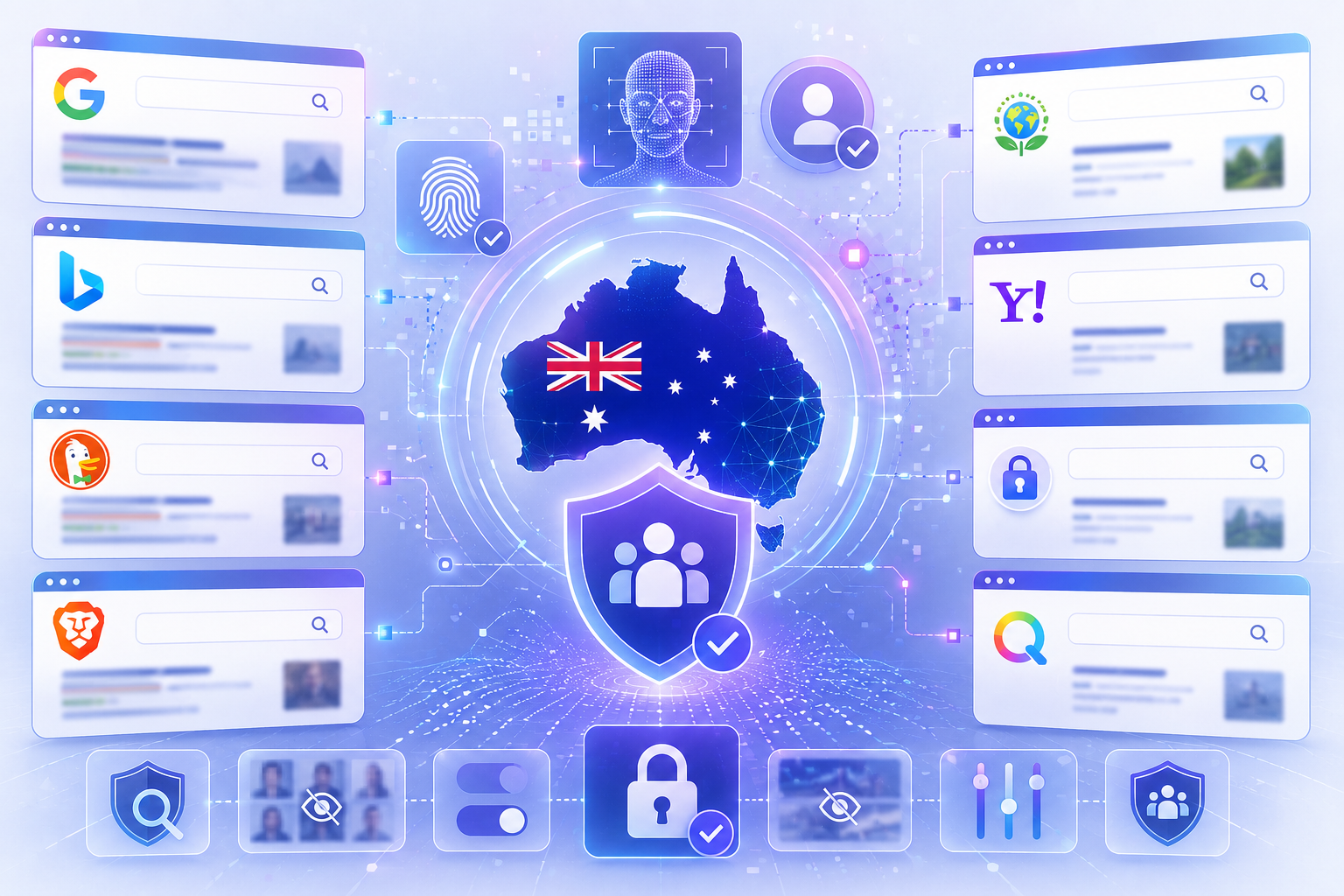
From 27 June 2026, Google and Microsoft must run age assurance for every logged-in Australian user of their search products under the Internet Search Engine Services Online Safety Code, registered by the eSafety Commissioner. The obligation reaches any product relying on search identity signals. This article covers what tech, growth and identity teams should already have decided.
Most of the public coverage frames this as a consumer story about children, safe search, and adult content. That framing misses where the operational pressure actually sits. The decisions that matter here are being made inside identity, growth, product, and platform teams across the Australian technology stack, and many of them are still being made the week of the deadline.
What the Code Actually Requires
The code binds internet search engine services operating into Australia. It covers Google, Bing, Yahoo, DuckDuckGo, and any other provider with Australian users. Google alone handles more than 90 per cent of Australian search queries, so for practical purposes this is a Google and Microsoft event.
Two requirements matter. First, search engine providers must apply age assurance to logged in account holders, where technologically feasible and reasonably practicable. They are not required to age check users who arrive logged out. Second, for any account the service assesses as likely to belong to a person under 18, the service must apply its highest safe search filter by default. The filtered categories include pornography, high impact violence, content promoting eating disorders, and other Class 1C and Class 2 material under the National Classification Scheme.
The eSafety Commissioner's guidance is explicit on three points. Age checks must be technically accurate, reliable, and fair. Providers must offer users more than one method of age check. Providers cannot rely solely on government issued ID as the basis for assurance.
The Allowed Methods Are a Stack, Not a Single Choice
The code names a deliberately broad set of acceptable methods:
- Photo ID verification (passport, driver licence, state issued ID)
- Facial age estimation using biometric models
- Credit card verification
- Digital ID (including providers connected to the Australian Government Digital ID System)
- Parental vouching
- Account based age inference using existing behavioural and profile data
- Third party age assurance services that have already verified the user
For a search engine at Google or Microsoft scale, no single method works for the whole logged in base. The realistic implementation is a tiered stack. Behavioural and account inference handles the quiet majority of users. Facial age estimation handles edge cases without forcing an ID upload. Government ID and digital ID sit at the back of the queue as appeal paths for users the inference layer wrongly flagged. The fairness requirement in eSafety guidance effectively forces this tiered shape, because a single mandatory ID method would fail the test.
This stack pattern is the model every Australian platform with a logged in audience will eventually be benchmarked against.
Why This Matters for Companies That Are Not Google
The obvious read is that this only binds the search platforms. The more useful read is that it sets the regulatory baseline for what age assurance looks like in Australia, and the same logic is already extending to other categories.
The social media age restriction regime, also driven by eSafety, came into force in late 2025 for under 16s and is being actively enforced. The Age Restricted Material Codes published earlier this year extend assurance obligations across app stores, hosting providers, and adult content services. The search code is the most visible deadline because it touches almost every adult Australian who uses Google while signed in, but it sits inside a much larger compliance architecture being assembled piece by piece.
Any Australian SaaS business, marketplace, fintech, healthtech or media platform with a logged in consumer surface should assume an age assurance obligation is coming within the next 12 to 24 months. The decisions worth making now are about the identity stack and the user friction model that will absorb it.
The Quiet Story Is Identity Plumbing
Age assurance did not exist as a distinct procurement category in Australia two years ago. It does now. Yoti, Incode, Onfido, Persona, Sumsub, AU10TIX, and Stripe Identity are pitching alongside facial age estimation specialists, and AGDIS aligned options like myID and ConnectID are now in the mix on the digital ID side.
For any product team building identity flows in Australia in 2026, three questions are now real:
- Do you treat age assurance as part of KYC, or as a separate consent and verification layer your existing KYC stack does not handle?
- If you adopt facial age estimation, what is your data minimisation and biometric retention story under the Privacy Act, the recent Privacy Amendment reforms, and OAIC biometric guidance?
- What happens when an Australian user refuses every method? Logged out experience, partial access, hard block, or graceful downgrade?
Teams that answer these questions in the next two quarters will be shipping. Teams that wait for a regulator letter will be retrofitting on a clock.
The Search Visibility Read
For growth, SEO and GEO teams the impact lands in two places.
Expect measurable changes in search behaviour from Australian users over the back half of 2026. A non trivial share of users will get caught in age estimation friction, will log out to avoid it, or will see filtered results. Any Australian business whose search traffic is concentrated in lifestyle, wellness, dating, gambling, alcohol, or any category that brushes against Class 1C or Class 2 material should be modelling traffic volatility now, not denying it.
The safe search default for younger accounts is going to filter content that is technically benign but algorithmically flagged. Brands that publish about eating habits, body image, mental health, weight loss, or alcohol should audit content against the National Classification Scheme categories, not only against Google's existing safe search rules. The classification scheme is broader and less forgiving.
The GEO question is sharper. Most AI answer engines do not yet apply age assurance in Australia, and there is no current instrument that requires them to. That asymmetry will not last. The eSafety code already contemplates extension to adjacent services, and the agentic AI guidance ASD's ACSC co published with CISA and the NSA in May 2026 has lifted the regulatory attention on AI mediated content. Content strategies that have shifted citation weight to ChatGPT, Perplexity, Gemini, and Google AI Overviews should expect age and safety obligations on those surfaces inside the next 18 months. The teams that have built strong author entity association and clear E-E-A-T signals on their content (Wai builds this layer through ARC) will absorb that change with less disruption than teams relying on anonymous or thinly attributed material.
What Boards and Executive Teams Should Be Asking
The compliance work belongs with the search platforms. The strategic work belongs with every Australian company that depends on search and identity. Three questions are worth raising at the next exec or board sitting:
- What is our exposure if Australian search traffic from logged in users drops 5 to 15 per cent in segments we depend on, and what is our diversification plan across direct, social, and AI engine surfaces?
- Do we have an age assurance architecture decision ready for our own logged in consumer surfaces, or are we waiting for a regulator to force one?
- If our brand or content touches anything in the Class 1C or Class 2 categories, do we have a content audit running this quarter, or will we discover the problem through delisting?
The answer to all three should already exist. If it does not, the deadline that lands tomorrow is the cue to put it on the agenda this week.
FAQ
What is the Australia search engine age verification deadline?
Search engine providers must have age assurance measures in place for logged in users by 27 June 2026. The Internet Search Engine Services Online Safety Code was registered on 27 June 2025 under the Online Safety Act 2021 and gave providers a six month implementation runway from the code's effective date.
Does age verification apply to logged out users in Australia?
No. The code requires age assurance only for logged in account holders. Users browsing Google, Bing, Yahoo, or DuckDuckGo without a signed in account are not subject to age checks under this code. Most Australians remain persistently signed in to Google or Microsoft for email, productivity, and cloud storage, so the practical reach is still close to universal.
What are the penalties for failing age verification in Australia?
Search providers can be fined up to approximately A$49.5 million per breach if they fail to meet the obligations in the code by the 27 June 2026 deadline. The eSafety Commissioner has the regulatory authority to issue infringement notices and to pursue civil penalty proceedings under the Online Safety Act 2021.
What age assurance methods are allowed in Australia?
The eSafety Commissioner allows a range of methods including photo ID verification, facial age estimation, credit card checks, digital ID, parental vouching, account based age inference using existing data, and third party age assurance services. Providers must offer users more than one method and cannot rely solely on government issued ID. The combined requirement effectively forces a tiered approach.
What do search engine age verification rules mean for Australian businesses?
For businesses with no consumer search exposure, the direct impact is limited. For businesses that depend on Australian search traffic, operate a logged in consumer product, or publish content that brushes against the National Classification Scheme categories, the rules signal where Australian regulation is heading. Age assurance is becoming a standard layer of the Australian identity stack, and any platform with logged in consumer users should expect similar obligations to extend within 12 to 24 months.
How should Australian companies comply with the age assurance code?
The code itself binds search engines, not most businesses. Companies operating logged in consumer products in Australia should treat the code as the regulatory pattern they will be measured against. Practical steps include mapping the identity flow against the eSafety fairness criteria, selecting at least two age assurance methods, settling a biometric data minimisation policy that holds up under the Privacy Act, and defining the user experience for refusal cases before a regulator defines it for them.
Which companies are affected by the Australia search code?
The code applies to all internet search engine services with Australian users. In practical terms, Google and Microsoft carry the largest exposure because Google handles more than 90 per cent of Australian search and Bing powers most of the remainder, including the Microsoft Copilot search surface. Yahoo, DuckDuckGo, and any other operator providing search to Australians is also bound by the code.
Sources
- eSafety industry codes and standards — eSafety Commissioner